Sunday, May 17, 2015

Beijing Bottles

Single-use bottles and bottle caps are among the most common things we find on Kehoe Beach. They come from our neighborhoods and from thousands of miles across the sea. Ocean currents are the great conveyors bringing us debris from all around the Pacific Rim. We find telltale product labels from Malaysia, Hong Kong, Singapore, China, Japan, Korea, India, even Russia and our bottles from the San Francisco Bay end up on distant shores.

In one day we found 27 drink bottles from Asia including one from the 2008 Beijing Olympics that took a four year trans-Pacific journey, arriving on Kehoe Beach in 2012 just in time for the London Olympics. The surface of the bottle is embossed with summer sports: swimming, archery. 

Water bottles are one of the most prevalent and most damaging plastics in the environment—and so easily replaced by adopting new habits. Carry a reusable bottle; tap water is more rigorously monitored than bottled water.

We propose a new addition to the 2016 Olympic medal events — the plastic water bottle transport. How many days will it take a bottle to float from Rio to Kehoe?

* 

Saturday, May 16, 2015

Umbrella Handles


French parapluie, against the rain.

Latin, parasol, against the sun.

The oldest written reference to a collapsible umbrella dates to Ancient China and the year 21 AD, but pictorial records go all the way back to 18th entry BC Egypt. The expense of manufacture dictated that their use was reserved for the noble classes. Umbrellas once only for the very rich are now found at the local Walgreens for $2.00, lasting just about two dollars worth. You can still find a fancy designer umbrella signifying status, and if status holds significance for you, you can buy a Burberry plaid design for $350 or a Louis Vuitton vintage model for $1200. Today the cheapness of umbrellas accounts for us finding so many handles. On any blustery rainy day the streets of every city are littered with the skeletonized corpses of blown out umbrellas all on their way to the beach.


    Finding Meaning in the Mess    Badè Museum of Biblical Archaeology, Berkeley, CA 

Monday, May 11, 2015

TURTLE WAX


Over the years we've found quite a few of these caps from Turtle Wax automotive wax/polish. In 1941, Ben Hirsch, the founder, traveled around Chicago to sell his product first called Plastone. He would station himself in a parking lot, polish one fender of a car and wait for the owner's return. Then Ben would sell them a bottle to finish the job. While in Turtle Creek, Wisconsin he was struck with the idea of "The Hard Shell Finish." The name of the town along with the by-line clicked. Turtle Wax is now the largest automotive appearance product company in the world.  The top hat on the logo came from Hirsch's hobby as an amateur magician. 


"Turtle Wax gives a magic shine."


Monday, March 23, 2015

Plastic Pledges


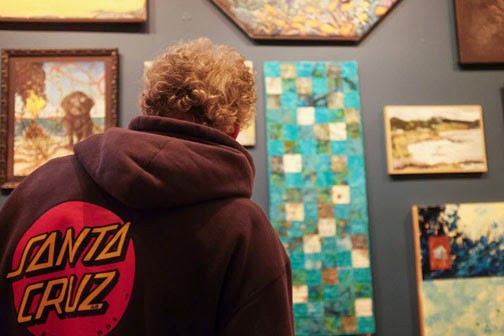
The Great Morgani, accordionist extraordinaire, kicked off the Blue festivities, an evening of exhibitions and events at the Santa Cruz Museum of Art and History. The big draw was Everybody's Ocean, a salon style floor to ceiling extravaganza part-crowd source, part curated. It's a love fest for 71% of the earths surface and in this case more than 71% of the gallery walls. 


Throughout the museum there were displays from ocean related organizations including our old friend Rachel Kippen from Save Our Shores and presentations from our new friend marine conservationist Sally-Christine Rodgers.

Our table top activity was billed as Feeling Blue. My able assistant, museum volunteer, nicknamed "Rat," set the stage by making the first example. All evening she encouraged visitors to sort through a mass of blue and colorful plastics to make make artful arrangements. Some folks just fooled around — putting one piece of plastic next to another in spontaneous constructions; others aligned the colors in balancing acts finding creative ways to make an elaborate tower of toothbrushes and straws stand up. All were astonished to learn that all of the plastic was from Kehoe Beach.


In the Lezin Gallery is our exhibit Plastic Pledges (until April 19). Looming overhead, hung from the ceiling is MAW a hulk of a tubular net, a piece of a trawl net with its mouth wide open to emphasize that it is clearly a mouth and digestive tube, that once scraped the seabed taking with it quantities of useable fish and along with it vast quantities of by-catch.

MAW, a gaping trap for all who enter its surround (fish, turtles, birds, marine mammals) carries a powerful message about the problem of industrial fishing practices and overfishing an already strained fish stock. As a twisting and powerful visual force it reinforces our message to stop eating fish, to give the ocean a break.


And, speaking of eating, our prints of plates full of plastic from our Unaccountable Proclivities series graced one area of the gallery and my shadow boxes of jewelry graced the other.

The center piece was a "kelp forest." Strands of rope with tags where visitors can write about their first memory of the ocean and what they pledge to do for the ocean.


After an evening with the calming influence of all that oceanic blue, the next morning it was a shock to the senses to see this window display in downtown Santa Cruz - talk about color!!! My eyes and my teeth hurt.


Sunday, March 15, 2015

CARE


In preparation for our upcoming exhibit at the Doug Adams Gallery we were introduced to the CARE community, an affiliate of the Graduate Theological Union. The Center for the Arts, Religion, and Education (CARE), promotes scholarship, reflection, and practice in the arts and religion to serve the Graduate Theological Union.

The party, billed as a "friendraising," certainly was. We were greeted by several old friends and made many new ones. Thanks to our hosts Suzanne and Devin Zuber for making sure that the weather was perfect, the sunset was glorious and the discussions were as dazzling as the sparkling lights of Berkeley, Oakland and beyond. Thanks to Elizabeth Peña and Lily Manderville the party planning was par excellence; with abundant and delectable refreshments to fuel the wide ranging conversations. Thanks to the Hannah and Yohana, volunteer student interns, who have started a blog that will give a behind the scenes look at the development of our project and exhibition. Thanks to Alla Efimova for posting the party pic on her Facebook page.

We were pleased to present the group our "artist statement" for our exhibit, Mining the Collection: Finding Meaning in the Mess:


What we leave behind, what every creature, every culture leaves behind. What the rocks as tales of mountains in motion leave behind. Archeology, Paleontology, Geology. All of these sciences study the remains of something that happened in time, something that left a mark. The fossilized bones of the Archaeopteryx— the Ur bird bridges the "missing link" in the biota of our world. History itself looks into the archives of politics, art, literature; what was left—Cézanne's apples, Mozart's The Magic Flute, the budgetary calamities of Louie XIV, the columns of Persepolis.


When we began thinking about our exhibit at the Doug Adams Gallery/Badé Museum, it was to be a simple exploration of our contemporary archaeology site — Kehoe Beach in the Point Reyes National Seashore. In response to the Tell en-Nasbeh collection we would simply catalogue and sort into some kind of coherence the plastic trash we find washing onto our favorite beach. Limiting ourselves to 1000 meters of that beach as a way of establishing a graspable metric in the welter of planetary bad news. A representative sample of what our culture is leaving behind.

Our search for meaning has taken us from the beach to this august institution, and rightly so. The search for meaning swings toward theology as a way of making sense of an untidy universe.

During our 20 year-long project we've been on an ongoing quest to find out how an aesthetic mind transforms plastic pollution into something meaningful, something beautiful to see. Along the way we've met the texts of powerful thinkers like Mary Douglas, Emile Durkheim, Mircea Eliade who all probe the question, what is allowed inside the Temple, the sacred space, and what must remain outside as the profane, as the "dirt?" We wonder if there is there an alchemy in the creative process linked to transformative action? After collecting over three tons of plastic from one beach we have tuned the simplest action of picking up trash to the highest value of re-enchantment. After all, we call our practice "Stoop Yoga" having bent over and picked every piece of plastic in this exhibit, one piece at a time. 


A child walking up the steps of Chicago's Art Institute asks, "Why are there these huge lions outside? This isn't the zoo!" This guileless question unfolds the image of libraries, museums, sanctuaries, shrines, tabernacles beset by toothy beasts. The archetypal guardians. The memorable fanged Bomas of Bali, above every temple doorway, eyes blazing, clawed hands raised in warning, may be just saying. "Booo!" Leave your fear at the door. Or may be saying, "Come in but only bring your best across this threshold." Leave your fear and your greed, pride, gluttony and sloth and the rest of human passion knotted in our ADD culture—come in and feel both your grief for the environmental plight we face as well as a little good humor at the human condition that brought us here. 

Lions at the gate? Chapter 7 of the Gospel of Thomas poses: "Blessed is the lion which the man eats, and the lion will become man; and cursed is the man whom the lion eats, and the lion will become man." Bringing this riddle into the sanctuary of the Bade Museum is turning the polemics of anger at consumer recklessness in to the solutions of joy, pleasure and understanding. The joy of discovery, the pleasure of collecting, and turning the hungry lions in our soul toward understanding the mess we have gotten ourselves in to. 

Finally, we return to the animistic beginnings when the world was an enchanted place where we can imagine everything/everyone was living in sacred space. Maybe this is a pipe dream but after years of work in our art studios we do know the enchantment of creative thinking leads out into a world where the temple evolves into the whole world, where we can transform the mess into meaning.


Tuesday, March 10, 2015

Vale of Tears


Claudia Chapline, curator, puts the finishing touches on Judith's Vale of Tears. Her invitation to participate in Connections, an exhibition at the Red Barn Gallery, was the prompt to get the water flowing in this piece composed of hundreds of pieces of candy, food and cigarette wrappers, plastic bags, translucent pieces of plastic collected from Kehoe Beach.

Connections is part of an arts program related to the 2015 literary conference “Mapping a New Geography of Hope: Women and the Land."

Claudia is a tireless supporter of the arts. Not only is she a fine artist, she is the instigator and visionary for Art Contemporary Marin a non-profit that presents art in public places throughout Marin County.

James Elkins in his Pictures and Tears: A History of People Who Have Cried in Front of Paintings tells stories about paintings that have brought people to tears.  A letter from Angela C. describes her trip to Tokyo and the extraordinary scene of the impeccably formal Japanese crowding in to view the painting scroll of Nachi Falls. Even the typically reserved elders were weeping. The painting awakened a religious experience for the onlookers who believed that it was not just a painting of God, but was God itself. The Nachi waterfall is a holy site and a stop for travelers on a religious pilgrimage.


Elkins laments the scarcity of tears today, attributing it to the head-over-heart school of art that has made crying passé.  Which brings me to the question —  have I ever been so moved by a painting that I was brought to tears? Could I create a work of art that would bring others to tears?

Any amount of plastic found on Kehoe Beach should evoke a tear. The amount of plastic displayed here (all from Kehoe Beach) should evoke a cascade of deep crying. 

We hope that while Vale of Tears is on display at the Red Barn Gallery it will be revered as a sacred site for meditation and reflection; a place on the trail to Kehoe Beach where pilgrims will go to pick up plastic.


Sunday, March 8, 2015

In Threes


While Judith was greeting her fans at the Geography of Hope exhibition, Doug Woodring, his dad Doug Sr, and Richard headed for the beach. Drakes Beach, that is.

The configurations of the cliffs along that stretch of strand (Purisima Formation outcrops) make it a perfect place to find fossils, sea creatures and rare stones. And on this day, the three found all three.

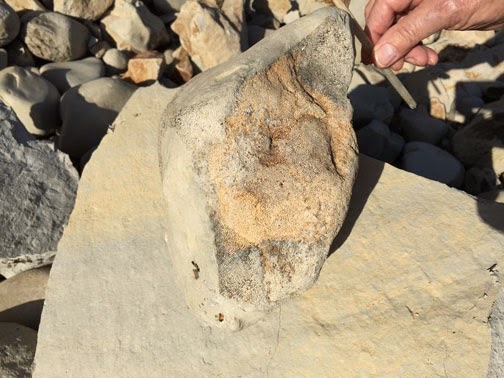
Doug won the day with his find of not one but two fossilized whale vertebrae and talk about sea creatures — an adorable baby shark!


Like the fossil hunters of Olduvai Gorge, it takes long hours of careful hunting to gain the skill to pick out something like a tiny plastic rock from the rubble at the foot of the Drake's Beach cliffs, the New Albion of Captain Drake's famous 16th Century landing. This nickel-sized plastic pebble—made in China, is one more piece of evidence that the world is both micro and macro. It's not one of the plastic stones described in the New York Times as a future fossil composed of plastiglomerate from the Anthropocene. Richard's stone was a singularity from our own Plasticene Discontinunity.


Doug, Sr holding the planet in place, hey… Got the world on a string, sittin' on a rainbow…

Sing it, Frank!